

September 14, 2026
The Rift War Escalates: A Review of the New Konflikt ’47 Starter Armies

The Rift War is getting some substantial reinforcements. Warlord Games has unveiled five new Konflikt ’47 starter armies, bringing a fresh force for every faction alongside new vehicle kits, additional build options, and considerably more plastic than their predecessors. These are not simply familiar collections with updated packaging. Several introduce new models and equipment options, with accompanying rules due to reach the free PDF army lists and Warlord’s app in time for release.
What catches our attention is how clearly each army commits to its own identity. There is something appealing about opening a starter army and immediately understanding its character, whether that means rampaging Ursus infantry or a formation of automated soldiers backed by heavy guns.
There is plenty here for new commanders and established collectors alike. Let’s break it down.
Soviet Bloc Elite Operational Group
The Soviet Bloc has arrived with a force that seems unlikely to spend much time negotiating.
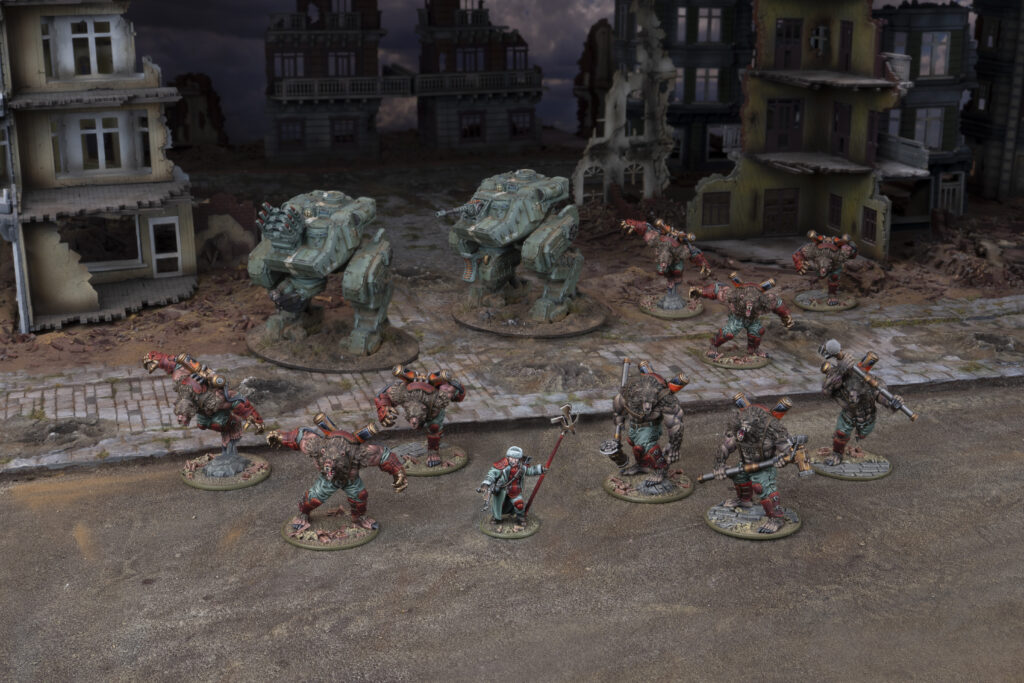
The Elite Operational Group replaces conventional infantry with an Ursus infantry core, supported by two of the new plastic DM-40 Molot medium walkers. The formation is built around supporting those rampaging bears rather than asking them to operate alongside a more traditional infantry force. Tooth, claw, and some particularly unpleasant hammers provide the personal introduction. The walkers handle the supporting firepower.
That commitment is what makes this box memorable. Rather than offering a little of everything, it puts a distinctive part of the faction at the center of the collection. For someone drawn to the Ursus models, that gives the army an immediate purpose and a cohesive identity.
The Molot is the major new kit to watch. Its plastic incarnation includes an extensive selection of weapons, including options that have not yet received rules. Warlord is saving the detailed sprue and rules breakdown for a later preview, so there is still more to learn about how those choices will distinguish one build from another.
Leading the formation is the returning box-exclusive Platoon Commander. This is the earlier exclusive sculpt with a revised hammer-and-sickle standard, rather than an entirely new commander. He is also the only Warlord Resin miniature in an otherwise plastic army.
For us, the attraction is straightforward: a strongly themed infantry force paired with two examples of a substantial new walker kit. When the armored walkers look like the restrained part of the formation, the army has probably made its intentions clear.
Axis Sonderkampfgruppe
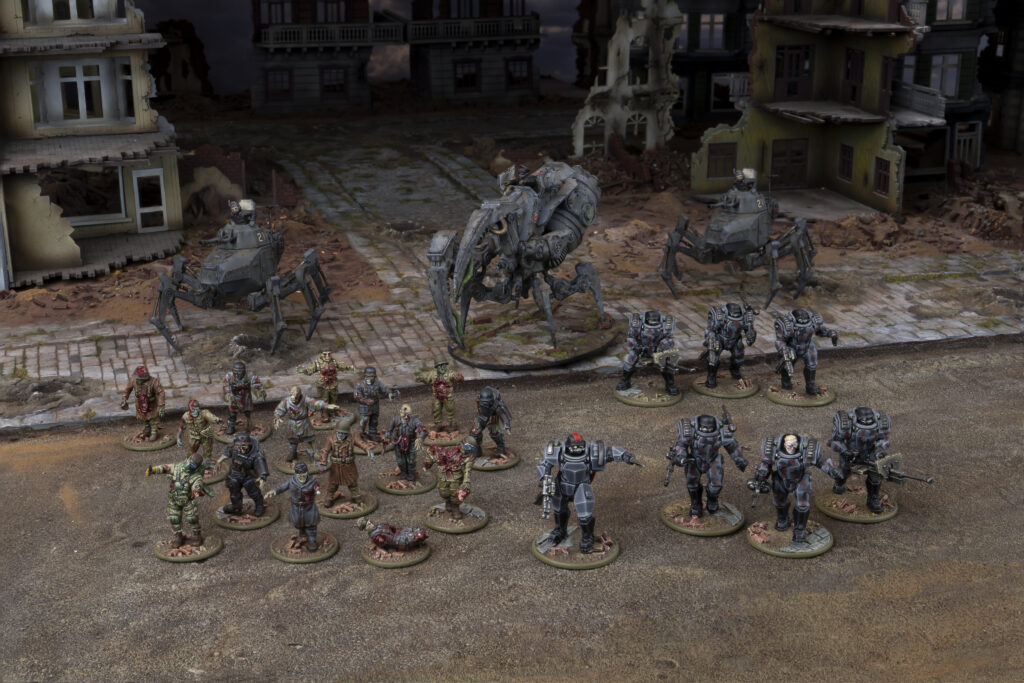
The Axis Sonderkampfgruppe takes a combined-arms approach, bringing together durable infantry and mobile walker support.
Plastic Stahltruppen and Totenkorps form the infantry core, with two Vogelspinne light walkers and a Nachtzehrer providing the faster-moving elements. The Nachtzehrer kit also offers a meaningful build choice: support the continued existence of your Totenkorps, or assemble the Infernospinne alternative and introduce the enemy to considerably more flame.
That contrast is the strongest part of the collection. The infantry supplies the stubborn center, while the walkers give the force something that can move beyond the pace of its foot soldiers. It makes for an appealing army concept without requiring every unit to approach the battle in the same way.
We particularly like that the alternate walker build connects to the character of the force. Supporting the undead infantry and adding a flame-focused vehicle are different directions for a collection, not merely different-looking weapons attached to the same model.
The returning Stahltruppen Platoon Commander leads the army in Warlord Resin. As with the Soviet set, he is the only non-plastic miniature in the box.
This is less about introducing a headline new vehicle and more about assembling an attractive cross-section of the Axis plastic range. There is room for that in a release wave. A starter army does not need every miniature to be new when the selection gives the faction’s existing kits a convincing home.
British Commonwealth Automated Battalion
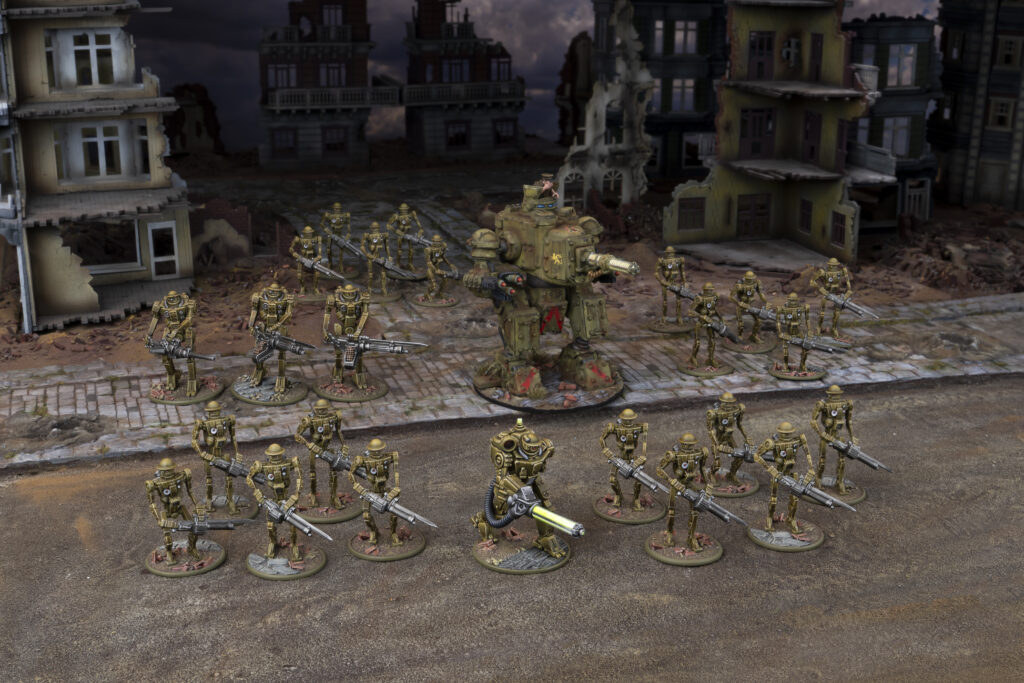
The British Commonwealth has apparently looked at its automated infantry and decided that the sensible next step is more automated infantry.
Twenty Mk I Automated Infantry form the heart of the Automated Battalion, accompanied by a Mk IIC Automated Director and a squad of Mk II Heavy Automated Infantry. The heavier machines contribute additional firepower and Data Transmission support, giving the formation more than a mass of identical mechanical soldiers. Every one of those infantry models is plastic.
The larger headline is the new plastic Percival. Its kit builds the familiar Percival configuration, the Hornet, and a third variant whose name and loadout Warlord has not yet revealed. Combined with the infantry, it makes this the first entirely plastic Konflikt ’47 starter army.
That makes the Automated Battalion a particularly interesting release from a collection-building perspective. It has a consistent mechanical theme, a substantial infantry core, and a new vehicle kit with several possible directions.
The unrevealed third variant is worth watching, although we would rather see its actual equipment than assign it a battlefield role from a teaser. The confirmed Percival and Hornet options already give the kit more to offer than a straight material change from resin to plastic.
Of the five armies, this is one of the clearest statements of intent. The emphasis is sustained firepower, with the machinery to match. Anyone whose preferred response to a battlefield problem is another line of guns will probably find something to appreciate here.
United States Rapid Deployment Force
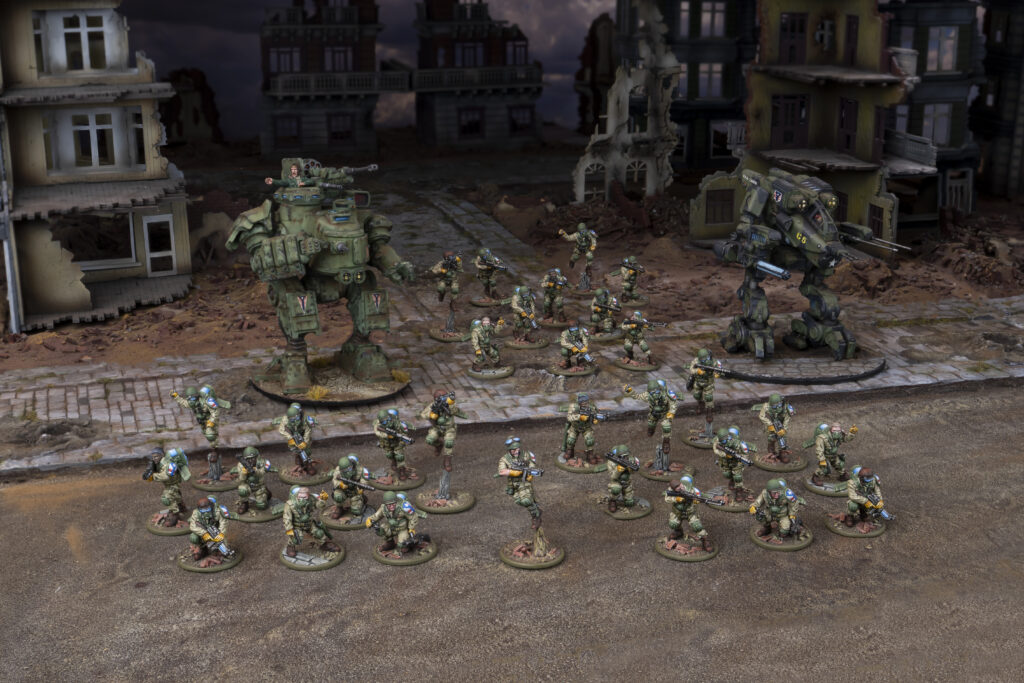
The United States Rapid Deployment Force is built around getting its troops where they are needed and bringing enough support to make their arrival count.
Firefly airborne infantry and Linebacker jump walkers supply the core of the formation, with the returning Firefly Platoon Commander leading them. The commander is the box’s only Warlord Resin model, continuing the near-all-plastic approach seen in the Soviet and Axis armies. The force’s stated role emphasizes rapid intervention, concentrated attacks, and redeployment before the enemy can respond.
That gives this army a different appeal from the Commonwealth formation. Where one leans into a concentration of automated firepower, the other is presented around mobility and choosing where to apply pressure.
The major new addition is the plastic Grizzly. This kit builds the standard Grizzly, the rocket-armed Bruin, or the heavily armed Kodiak, giving the force a substantial vehicle release alongside its established jump-capable units. Warlord has also teased additional surprises on the sprues, although those details are still being held back.
The three confirmed builds are enough to make the Grizzly worth watching. A vehicle kit becomes more interesting when its alternatives can give separate models their own identity, rather than making every addition to the collection look like a duplicate.
For existing US collectors, the new walker may be the main attraction. For someone starting fresh, the combination of mobile infantry, jump walkers, and heavier support gives the box a coherent theme without making the entire collection revolve around one type of miniature.
Empire of Japan Long Range Penetration Group
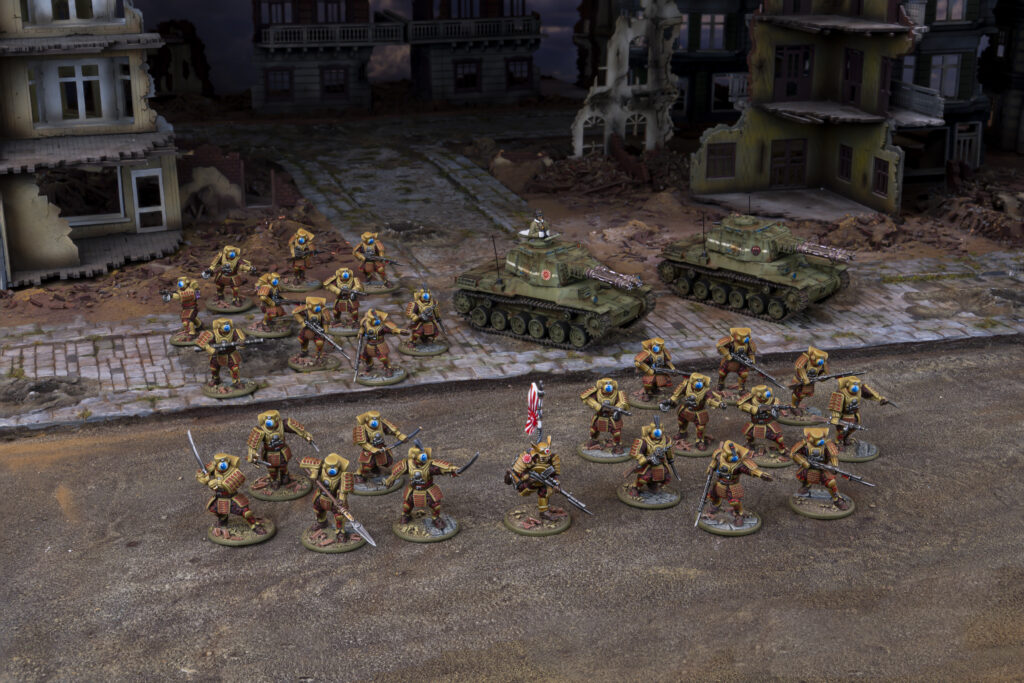
The Empire of Japan brings a formation built around Ghost Attack Infantry, maneuver, and some welcome armored support.
Ghost and Shadow squads provide the infantry core, using their Rift-tech to outflank and disrupt enemy positions. The returning Platoon Commander in Assault Frame Heavy Armour is included, although collectors can instead build a Ghost Infiltration Platoon Commander from the plastic infantry components.
That alternative commander is a thoughtful inclusion. It gives players a way to lean more fully into the Ghost theme rather than making the army’s leader feel separate from the units surrounding him.
The substantial new hardware comes in the form of two plastic Chi-Nu medium tanks, each supplied with a new resin turret mounting two Shiboru Cannon barrels. The kits also retain the option to use the conventional Medium Anti-tank Gun configuration. The twin-barreled turret’s rules have not yet been revealed, so its exact capabilities remain an open question.
The material distinction matters here. These are plastic tanks with resin Rift-tech turrets, not entirely plastic versions of the new configuration.
As an army concept, the pairing is appealing. The tanks provide the supporting firebase around which the Ghost units can maneuver, giving the collection two visually and thematically distinct elements that still belong together. We will need the weapon rules before judging what those new turrets add in game terms, but they give the Japanese vehicles a clear point of interest beyond simply including more armor.
Nearly All Plastic, With More to Come
The shift toward plastic is the thread connecting this release, but it is worth keeping the distinction clear. The Commonwealth army reaches an entirely plastic lineup, while the other formations still include the resin elements described above.
Warlord has also clarified that these starter armies are not being presented as limited editions. Their contents may be revised again as more plastic kits become available, but the company says the models players purchase will remain supported in the rules. This is an evolving range, not an announcement that the included units are on their way out.
There is another useful point for established collectors: the new plastic vehicles appearing first in these armies are not intended to remain box exclusives. Individual releases are planned, although the announcement does not provide specific dates.
That is welcome news. A themed army box can be an attractive starting point without needing to become the only route to a vehicle someone wants for an existing collection.
Our Take
The strongest part of this wave is that the five armies do not feel interchangeable. Each gives collectors a recognizable concept to build around, while the new vehicle kits provide reasons for established players to pay attention as well.
The Soviet force stands out to us for its commitment to Ursus infantry and the arrival of the plastic Molot. The Commonwealth box is another highlight, both for its automated theme and for reaching the all-plastic milestone. The Grizzly’s multiple builds and Japan’s revised tank turrets also give this release interest beyond the contents of the starter armies themselves.
There are still details to come. The announcement leaves several new equipment rules unrevealed and does not provide the complete pricing and points information needed for a meaningful value or competitive comparison. Our enthusiasm here is for the miniature selection, the build options, and the direction of the range.
On those terms, this looks promising. Five distinct forces, new hardware, and more choice over how a collection takes shape give this wave plenty to offer without needing to declare a battlefield winner before the rules arrive.
The Rift War is getting louder, stranger, and considerably more crowded. We are particularly interested in what steps off those new vehicle sprues next.
Images: Warlord Games.