

September 17, 2026
Salamanders Turn Up the Heat as Raven Guard Get Even Harder to Pin Down

Games Workshop has reached the more Codex-compliant Chapters in its run of Space Marine detachment previews, and the Salamanders and Raven Guard are getting two of the clearest examples yet of how the new system can make a Chapter feel different without locking it away from the rest of Codex: Space Marines.
Neither update is trying to reinvent the faction. Instead, the Salamanders are becoming better at fighting exactly where they want to fight, while the Raven Guard are leaning much harder into movement, concealment, and controlling when the enemy can actually engage them.
Salamanders Want to Be Right in Your Face
Forgefather’s Seekers returns for the Salamanders, and its identity is about as subtle as a flamer at twelve inches.
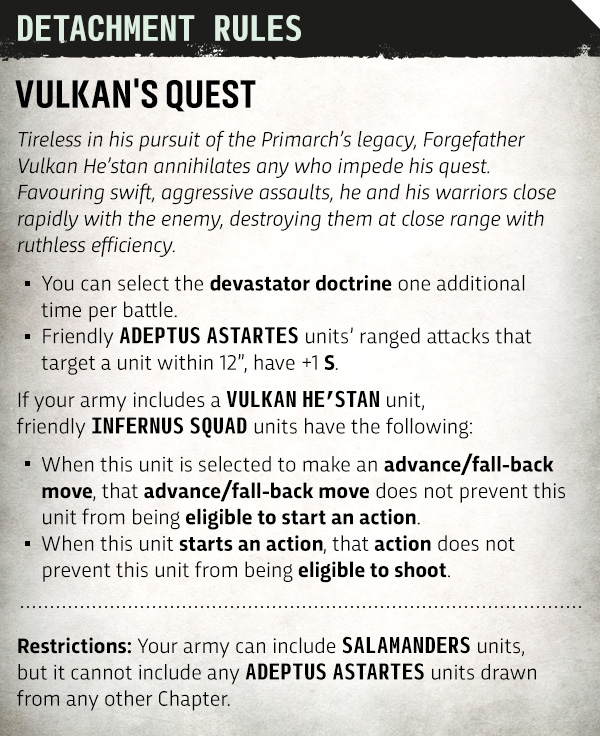
The updated Vulkan’s Quest rule allows the army to select Devastator Doctrine one additional time per battle while giving friendly Adeptus Astartes ranged attacks +1 Strength when targeting units within 12". If Vulkan He’stan is in the army, Infernus Squads also gain considerably more flexibility around actions, allowing them to remain eligible after Advancing or Falling Back and continue shooting after beginning an action.
That short-range Strength bonus is probably the part most Salamanders players will notice immediately.
It does not force the army into one specific weapon type. Flamers obviously fit the theme, but every qualifying ranged weapon benefits as the Salamanders close the distance. That gives the detachment a clear battlefield identity without simply turning it into “the Infernus Squad detachment.”
The new Forged in Fire Stratagem pushes the flamer side considerably further.
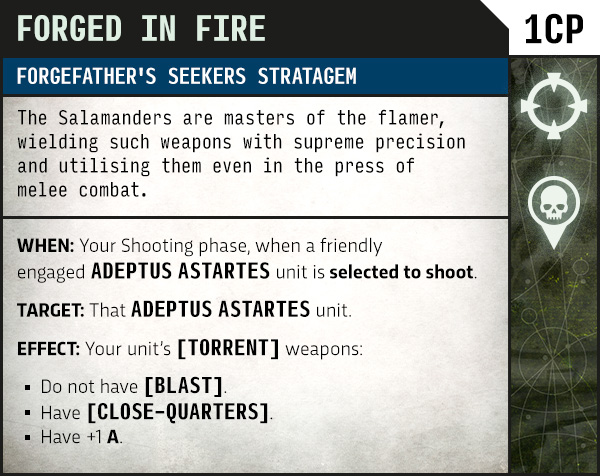
Torrent weapons are changing in the new rules, with common flamers receiving fixed attacks and Blast. Normally, that creates restrictions when a unit becomes engaged. Forged in Fire removes Blast, adds Close-Quarters, and gives those Torrent weapons +1 Attack for the phase. In other words, tying up a Salamanders unit in melee may not stop the flames nearly as effectively as you hoped.
Wrath and Ruin adds another useful option, allowing an Adeptus Astartes Infantry unit to activate either Assault or Tactical Doctrine until the following Command phase.
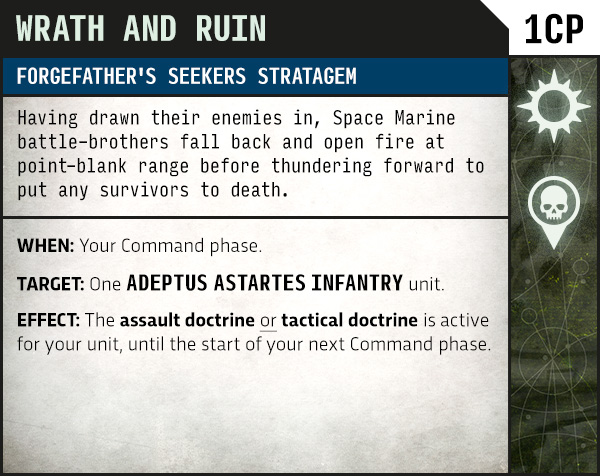
This is probably what we like most about the Salamanders preview. The rules do not just make flamers numerically better. They make the army better at forcing and surviving the kind of close-range engagement the Chapter is supposed to excel at.
Raven Guard Are Playing a Different Game Entirely
The Raven Guard’s Shadowmark Talon goes in almost the opposite direction.
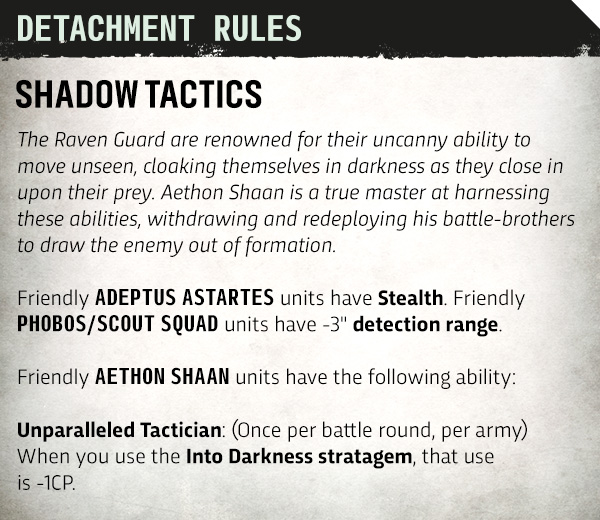
Every friendly Adeptus Astartes unit gains Stealth. Phobos and Scout Squad units then push the concealment game further with a -3" detection range, while Aethon Shaan can reduce the cost of the Into Darkness Stratagem once per battle round.
Giving Stealth to the entire army is already significant, but the interaction with Phobos units is where the detachment starts to feel properly Raven Guard.
Those units are already receiving additional movement in the new codex, and Shadowmark Talon builds around that mobility rather than simply handing them another offensive bonus. The result looks like an army designed to move into position, force awkward target choices, and make the opponent work harder to interact with the units that matter.
Suppressed Weapons may be the most thematic rule in the preview.
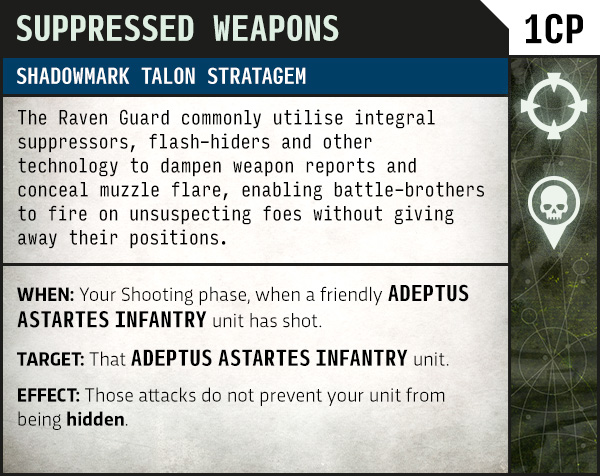
For 1CP, an Adeptus Astartes Infantry unit can fire without those attacks causing the unit to stop being hidden. Importantly, that rule is not limited to Phobos units. The detachment can therefore extend its stealth mechanics to heavier infantry that would normally be much less subtle.
We will need the complete rules and points before deciding how powerful that actually is, but the design is interesting. Raven Guard are not merely receiving another version of “shoot better while in cover.” They are gaining tools that change how and when the opponent can respond to them.
The Other First Founding Chapters Are Not Being Left Behind
Games Workshop also confirmed updated specialist detachments for the Ultramarines, Iron Hands, and Imperial Fists. Each will receive four Enhancements and six Stratagems, while the Iron Hands and Imperial Fists detachments are both 2DP options.
That last part matters because it leaves room to combine them with one of the 1DP detachments from Codex: Space Marines.
GW specifically calls out pairing the Imperial Fists’ Ceramite Sentinels with Gravis Siege Force, while Raven Guard players can combine Shadowmark Talon with Phobos Shadow Force for an even more specialized Vanguard army. White Scars players are covered as well, with Stormlance Task Force already appearing inside the new codex.
Our Take
Of the two detachments shown today, Raven Guard may have the more unusual rules, but Salamanders probably have the easier identity to understand immediately.
Get close. Make the guns hit harder. Keep the flamers working when the enemy tries to shut them down.
Raven Guard ask a different question: how much of the battle can you control by simply making yourself difficult to engage on the opponent’s terms?
Both are good examples of what this new detachment structure should be doing.
A Salamanders army should not feel like black-armored Marines painted green with a flamer bonus stapled onto them. A Raven Guard army should not just be ordinary Marines receiving cover slightly more often. These rules appear to be moving both Chapters toward battlefield behavior that actually matches their character.
We still need the complete codex, points, and wider rules environment before making any judgments about strength.
But in terms of faction identity, this looks like a solid finish to Games Workshop’s week of Space Marine detachment previews.